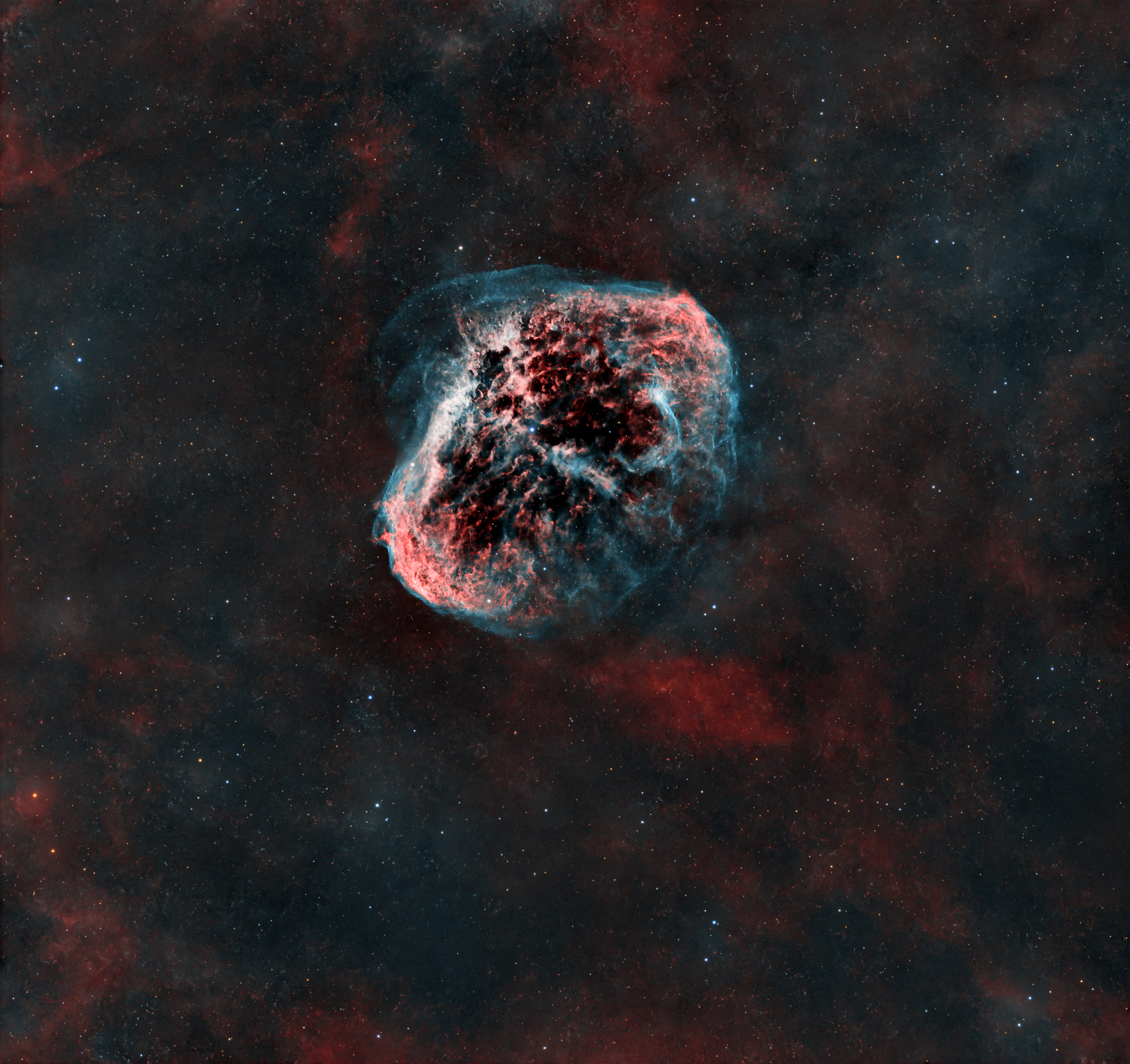
NGC 6888 – The Crescent Nebula
NGC 6888
NGC 6888, better known as the Crescent Nebula, is an emission nebula around 5,000 light-years from Earth, in the constellation Cygnus. Its striking shape was carved by the powerful stellar wind of the star at its center, WR 136, a Wolf-Rayet star in one of the final and most dramatic stages of its life.
When WR 136 was a red supergiant it was slowly shedding a dense shell of gas into space. As it evolved into its current Wolf-Rayet phase, everything changed: the star began blasting material away at thousands of kilometers per second, and that much faster wind eventually caught up with the older gas it had expelled earlier. The result is a colossal cosmic traffic crash: the gas is compressed, heated, and made to glow, creating the beautiful shell we know as the Crescent Nebula.
The different colors tell part of that story. The star’s intense ultraviolet light excites hydrogen, making it shine in the deep red of Hα, while the violent shock waves generated by those colliding winds produce the cyan glow of doubly ionized oxygen, wrapping it up like a veil.
Like many beautiful things in the universe, it won’t last forever. WR 136 is burning through the final chapters of its life and is expected to end as a supernova within the next few hundred thousand years. When that happens, the explosion will completely reshape — and likely destroy — the fragile bubble the star is creating today, and we wouldn’t see it until roughly 5,000 years afterward.