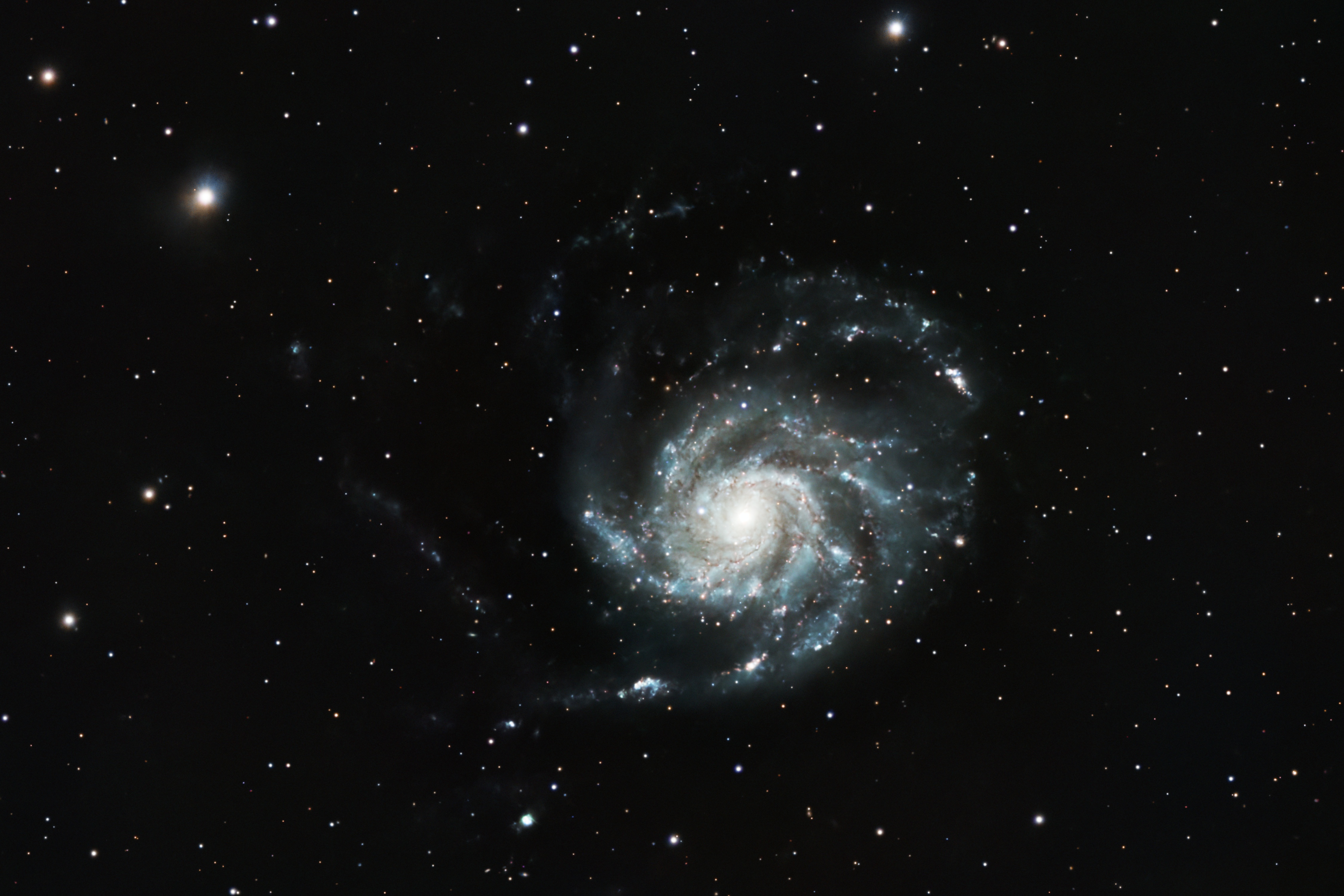
Messier 101 – The Pinwheel Galaxy
M101
Messier 101, the Pinwheel Galaxy, is a face-on grand-design spiral in Ursa Major, sitting just off the handle of the Big Dipper at a distance of roughly 21 million light-years. Spanning about 170,000 light-years across, it is nearly twice the size of our own Milky Way and is thought to contain close to a trillion stars. Its broad, slightly asymmetric arms are dotted with bright pink HII regions — large star-forming nebulae, several prominent enough to carry their own NGC designations — which is exactly what makes it such a rewarding target in both broadband and narrowband.
This is a cumulative project captured over five nights from my Bortle 7 backyard in San Pedro de Alcántara, Málaga, Spain. Most of the signal is broadband: 487 × 120 s through an Optolong L-Pro filter — about 16.2 hours — carrying the resolution and the faint outer structure, including the tidal plume trailing below the disk. To lift the HII regions I added 34 × 300 s with an L-eNhance dual-band filter (about 2.8 hours), used purely to extract Hα and OIII for color. Roughly 19 hours in total.
Processing was done entirely in PixInsight. Calibration and integration ran through WBPP with 2× drizzle to make the most of the five-night dataset. After gradient removal with GraXpert and deconvolution with BlurXTerminator, color was calibrated using SPCC; the stars were then separated with StarXTerminator, the starless galaxy denoised with NoiseXTerminator and stretched with GHS. The Hα and OIII were blended into the broadband as a gentle HOO overlay to give the star-forming regions their natural red and cyan tones, and the stars were stretched separately before being recombined. I kept the saturation deliberately restrained — M101 is fundamentally a blue spiral with discrete red HII knots, to maintain a natural look.