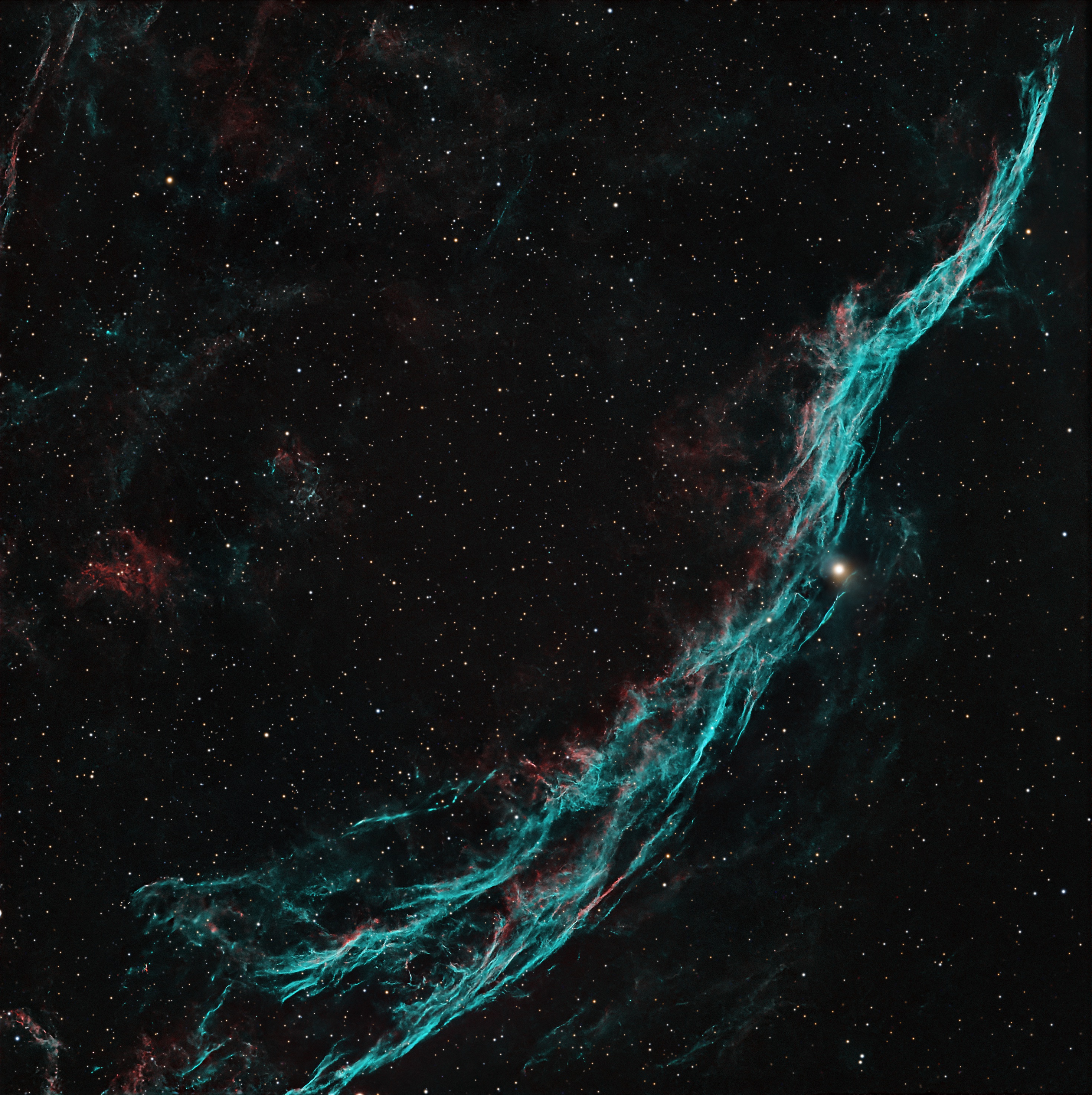
The Dragon in the Veil
NGC 6960
The Western Veil is part of the Cygnus Loop, the expanding remnant of a star that went supernova somewhere between 10,000 and 20,000 years ago. What we see today are the thin, twisted filaments of gas left behind by that explosion, still glowing as the shockwave plows through the surrounding interstellar medium. The bright star anchoring the western edge is 52 Cygni — a foreground star, not physically connected to the nebula, but a handy landmark that sits right on the brightest braid of filaments and gives the whole region its “witch’s broom” nickname.
Captured over two nights from my backyard in southern Spain under Bortle 7 skies. I used two filters for two different jobs: a broadband L-Pro for the stars (81 × 30 s), and a dual-band L-eNhance for the nebula detail (63 × 300 s across both nights). The second night fought me a bit — the Veil was low over the horizon and right behind the light dome of the nearby town — so a fair chunk of those subs didn’t survive culling, but enough made it through to add depth to the faint outer filaments.
Processing in PixInsight. The two masters were stacked and aligned in WBPP, then cleaned of gradients with GraXpert and sharpened with BlurXTerminator. The narrowband data was split into Hα and OIII channels, stretched with GHS, and mapped into an OHH palette using Seti Astro’s Perfect Palette Picker — which is where the strong red-and-blue contrast across the shockfront comes from. I pulled a luminance layer to recover fine structure with HDRMultiscaleTransform and LocalHistogramEqualization, then folded it back in. The stars were processed separately from the L-Pro broadband for natural colour and added back at the end.
Thanks to Marc Abelló for the great tips on processing OSC data with narrowband filters — his video walkthrough covers the process.