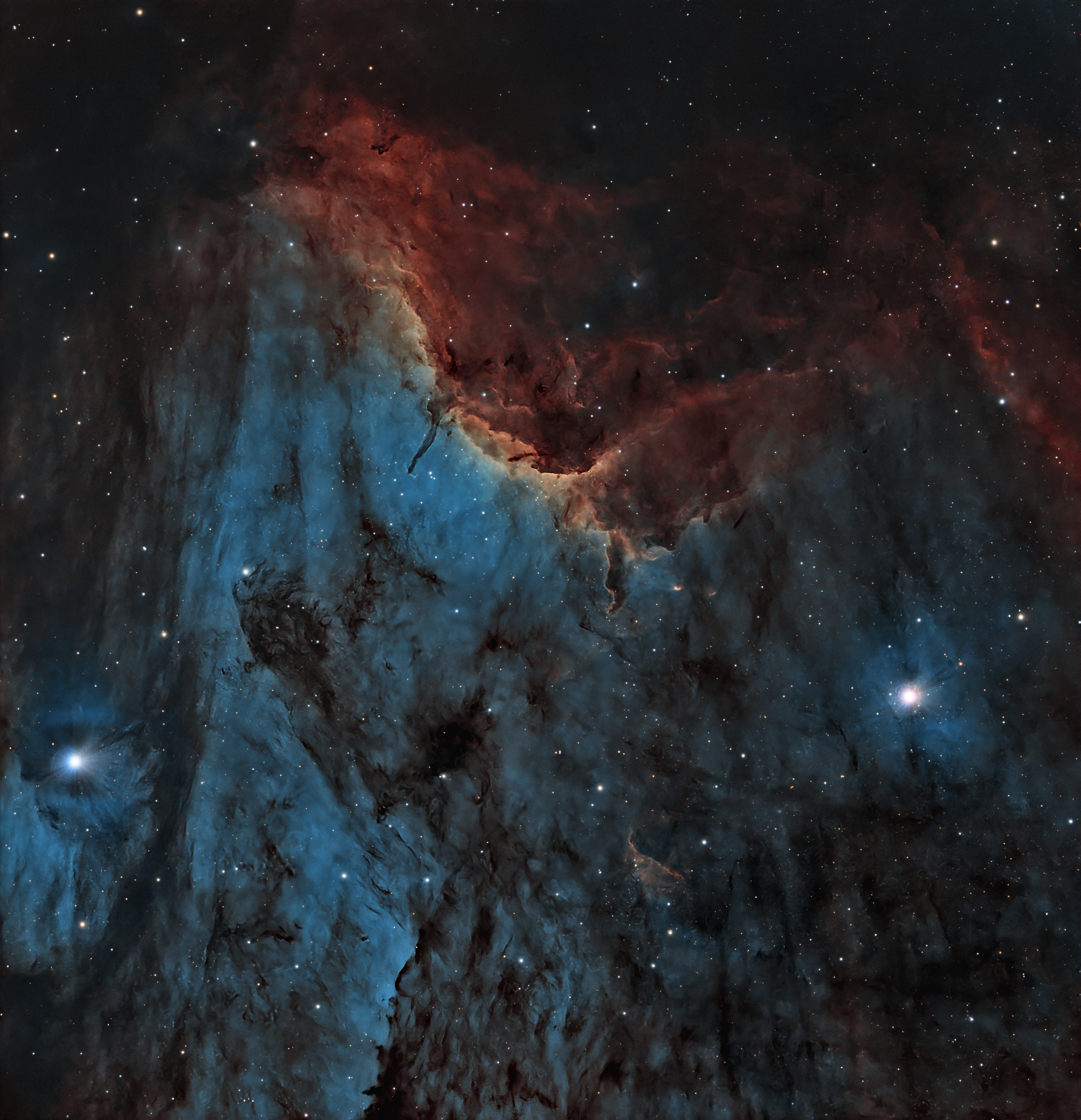
IC 5070, the Pelican Nebula
IC 5070
The Pelican Nebula (IC 5070) lies in the constellation Cygnus, the Swan, right beside its larger and more famous neighbour, the North America Nebula — the two separated only by a dark river of cold cosmic dust. It is a vast cloud of glowing gas roughly 1,800 light-years away, and it owes its name to the unmistakable shape its brighter regions trace against the sky. The most striking feature is the bright, wavy ridge cutting across the centre: an ionization front, where the fierce radiation of nearby young stars is slowly eating into the surrounding gas, making it glow and sculpting the dark, finger-like columns of dust that stand out in silhouette.
This image is the result of four nights under Bortle 7 skies in San Pedro de Alcántara, Málaga, Spain, for a total of just over 18 hours of integration. Most of that time was spent through narrowband filters, which isolate the light emitted by specific gases — hydrogen, sulphur and oxygen — and let their faint, delicate structure show through even from a bright suburban location. A short run through a broadband filter was added purely to record the stars in their natural colours.
The processing was done using PixInsight. The three gas signals were separated using DBXtract and recombined in the “Foraxx” palette, which gives the scene its warm golden ridge and cool teal body. Finally, the stars recorded through the broadband filter were blended back in, and a last pass of contrast and colour brought the whole image together.