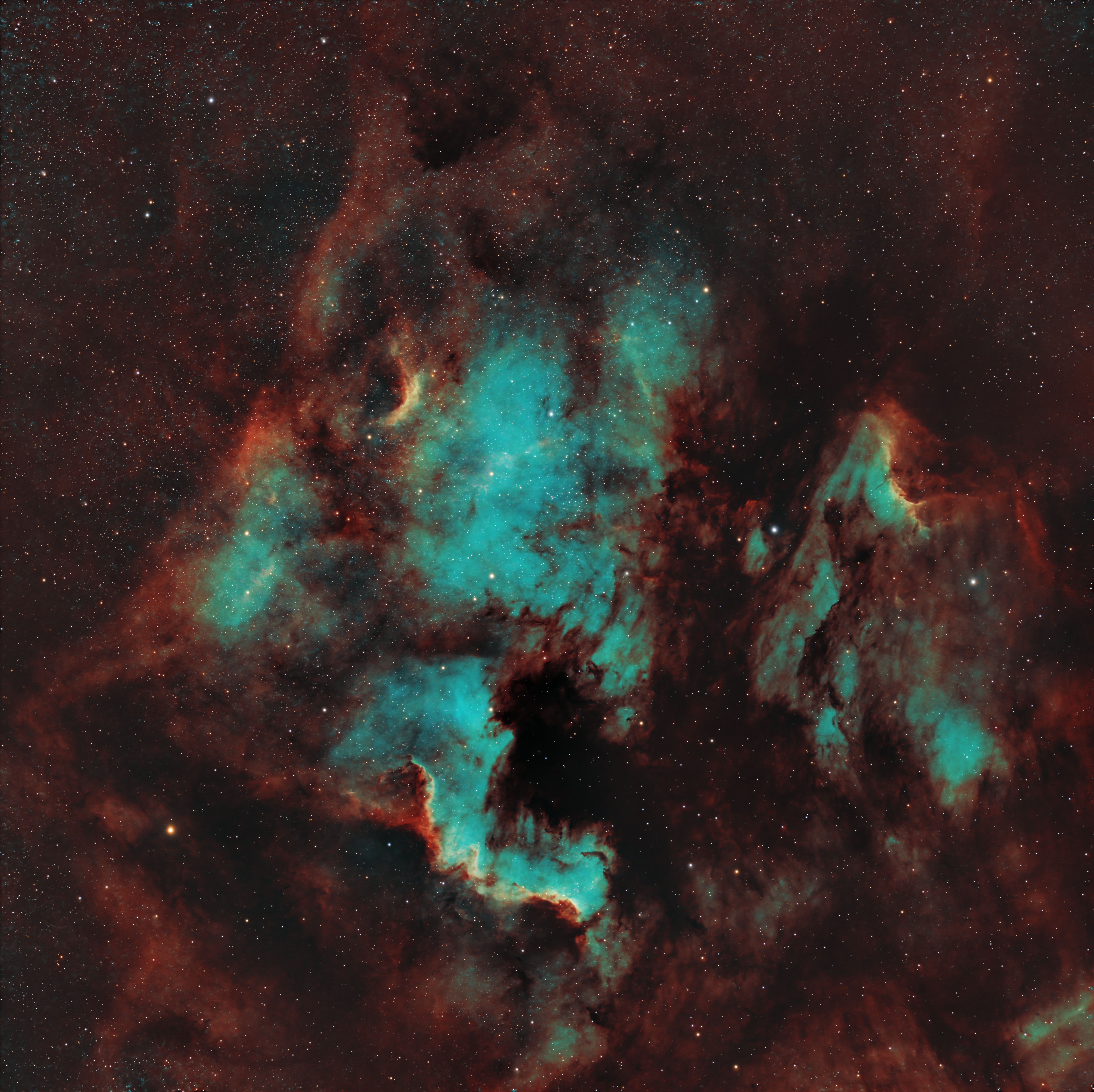
The North America and Pelican Nebulae (Foraxx)
NGC 7000
The North America and Pelican Nebulae sit next to each other in the same large cloud of gas and dust, 2,590 light years away, in the Cygnus constellation. The North America Nebula gets its name from its familiar outline, while the Pelican Nebula looks a bit like a pelican seen from the side. The resemblance is just a coincidence, though. The shapes are created by a dark dust lane called LDN 935, which blocks the light from the glowing gas behind it.
Despite having separate catalog numbers, the two nebulae are really parts of the same region. They are illuminated by the same massive star hidden deep within the dust, whose ultraviolet light causes the surrounding hydrogen gas to glow red. Small amounts of oxygen add some of the blue-green color visible in parts of the field.
The bright ridge along the “Mexico” edge of the North America Nebula is known as the Cygnus Wall. It is an active star-forming region where radiation from nearby young stars is gradually wearing away the gas while also compressing parts of it into new stars. Together, the North America and Pelican Nebulae cover an area several times wider than the full Moon, which is why fitting both into a single frame usually requires a fairly wide field of view.