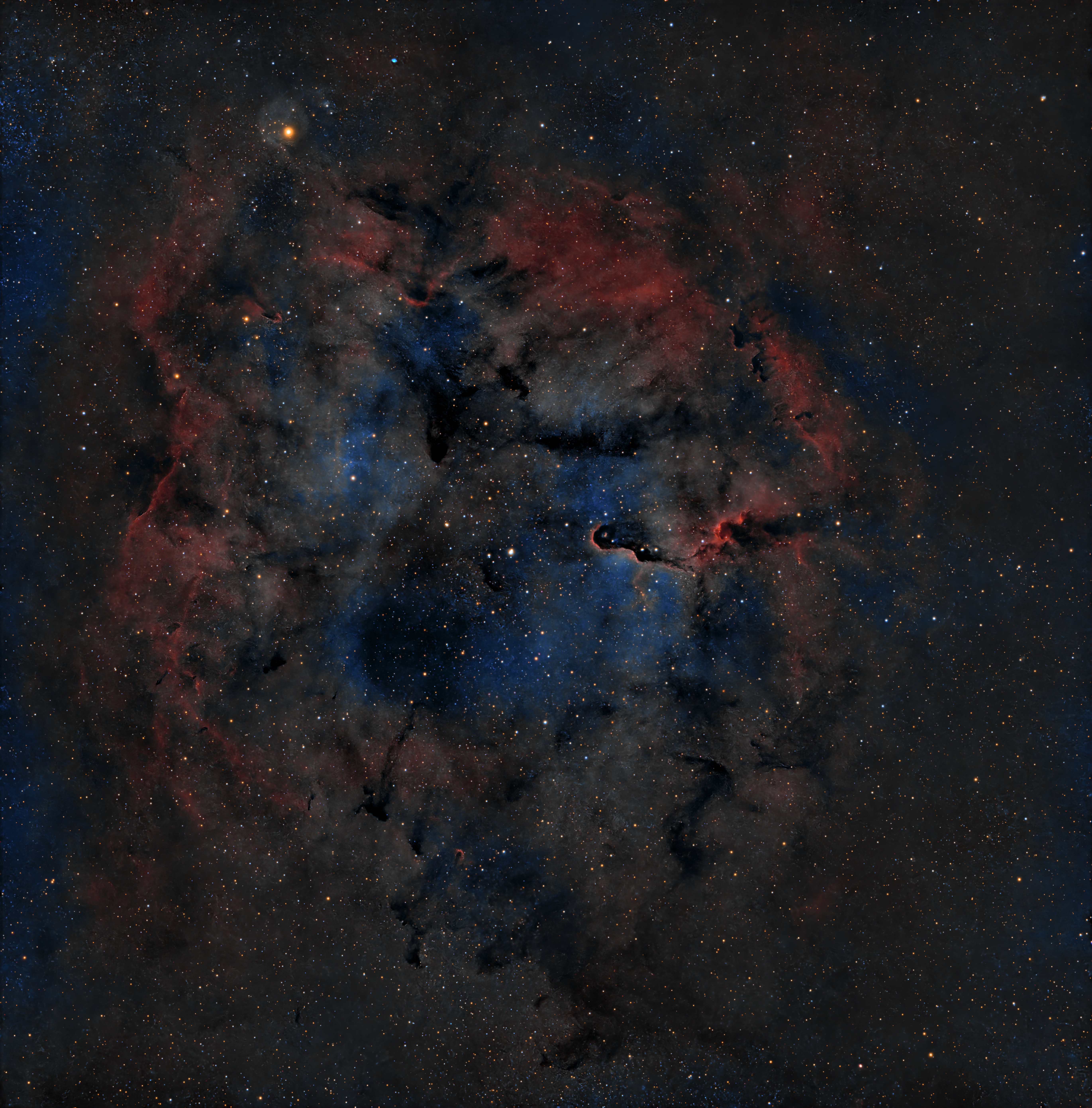
Mu Cephei Watching Over the Elephant's Trunk Nebula
IC 1396A
Mu Cephei, also known as Herschel’s Garnet Star, is a red supergiant, one of the largest and most luminous stars visible to the naked eye: if it replaced the Sun, its surface would swallow the inner planets and reach out toward the orbit of Jupiter. Someday it will end as a supernova — but for now it just sits there, perched at the top of the frame, glowing that unmistakable garnet red over the whole IC 1396 complex.
The Elephant’s Trunk Nebula, or IC 1396A, is one of those objects where astronomers didn’t have to think too hard about the name. It really does look a bit like an elephant’s trunk. Located about 2,400 light-years away in the constellation Cepheus, it’s a dense cloud of gas and dust sitting inside the much larger IC 1396 nebula.
The bright rim around the dark cloud is illuminated and ionized by HD 206267, a hot, massive star located near the center of the larger IC 1396 complex. Its intense ultraviolet radiation is basically giving the surrounding gas a very hard time, carving out the nebula and creating the bright edges we see in images.
But this isn’t just a pretty cloud. The Elephant’s Trunk is also a stellar nursery, with young stars forming inside the dense gas and dust. The radiation and stellar winds from nearby massive stars compress the material, helping trigger the formation of new stars.
So, beneath all those beautiful colors, there’s actually a pretty violent process going on. Space, as usual, manages to make chaos look spectacular.